
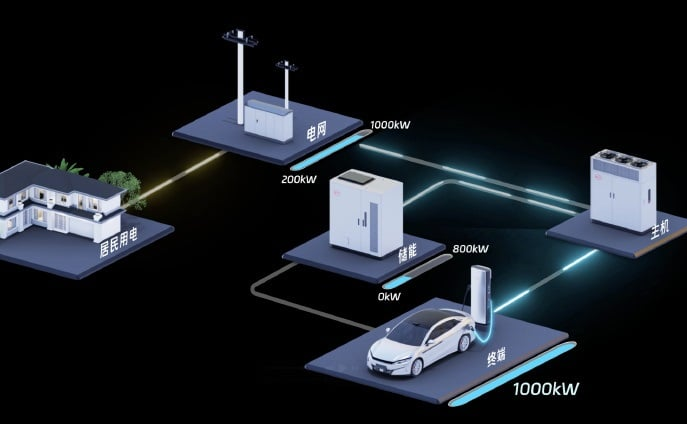
As the demand for rapid EV charging grows across North America, a new generation of ultra-fast charging systems is emerging. The image above illustrates a 1,000 kW (1 MW) high-power charging architecture, designed to dramatically reduce charging time while stabilizing the electrical load on the grid.
The Rise of 1,000 kW Ultra-Fast EV Charging Technology
A new breakthrough in high-power EV charging is emerging as global manufacturers begin showcasing 1,000 kW (1 MW) ultra-fast charging architecture designed for next-generation electric vehicles. This megawatt-class system is engineered specifically for high-demand charging hubs, fleet depots, highway stations, and heavy-duty electric trucks, marking a major evolution in how quickly EVs can be recharged. The architecture integrates a robust 1 MW grid interface, high-capacity transformers, industrial switchgear, and real-time protection systems to manage massive power delivery safely. By distributing energy through advanced power electronics and smart metering, these charging hubs reduce strain on local grids while enabling unprecedented charging speeds. As North America prepares for large-scale electrification, this 1 MW platform is positioned to become the foundation of future public fast-charging networks, offering the performance needed for 800V to 1500V EV platforms.
Energy Storage, Power Stabilization & High-Efficiency DC Architecture
A defining feature of the 1,000 kW charging system is the integration of a 200 kW energy storage system (ESS), designed to buffer grid demand and ensure stable, efficient power delivery. Using high-density LFP battery modules, liquid-cooled thermal systems, smart BMS controls, and grid-tied inverters, the ESS smooths power flow during peak periods and stores energy during low-cost off-peak hours. This dramatically reduces grid stress—one of the biggest challenges in scaling high-power EV infrastructure. The stored energy is then routed into an 800 kW high-power DC charging cabinet, equipped with harmonic suppression, active cooling, and DC-DC power modules that create a clean, regulated output for ultra-fast charging. This advanced energy-management model allows charging stations to maintain consistent power delivery, even in dense urban locations or during high-traffic fleet operation.
1 MW Charging Terminals & Smart Microgrid Integration
The final stage of the architecture is the 1,000 kW charging terminal, capable of delivering megawatt-level DC power directly to next-generation EVs. Designed for 800V–1,000V battery platforms, these chargers use dual liquid-cooled cables to handle extreme current while preventing overheating. Vehicles compatible with this emerging standard may achieve 10–12 minute charging times from 10% to 80%, representing one of the fastest recharge rates under development. The system also supports smart microgrid integration, automatically balancing power between residential loads, the main utility grid, the ESS, and the charging port. This intelligent energy distribution reduces operational costs, enhances reliability, and supports future V2X and bidirectional charging applications. As EV adoption expands across Ontario, Canada, and the broader North American market, this 1 MW architecture is expected to redefine ultra-fast EV charging by offering unmatched speed, stability, and scalability for commercial and consumer platforms alike.